

By Neta Nwosu
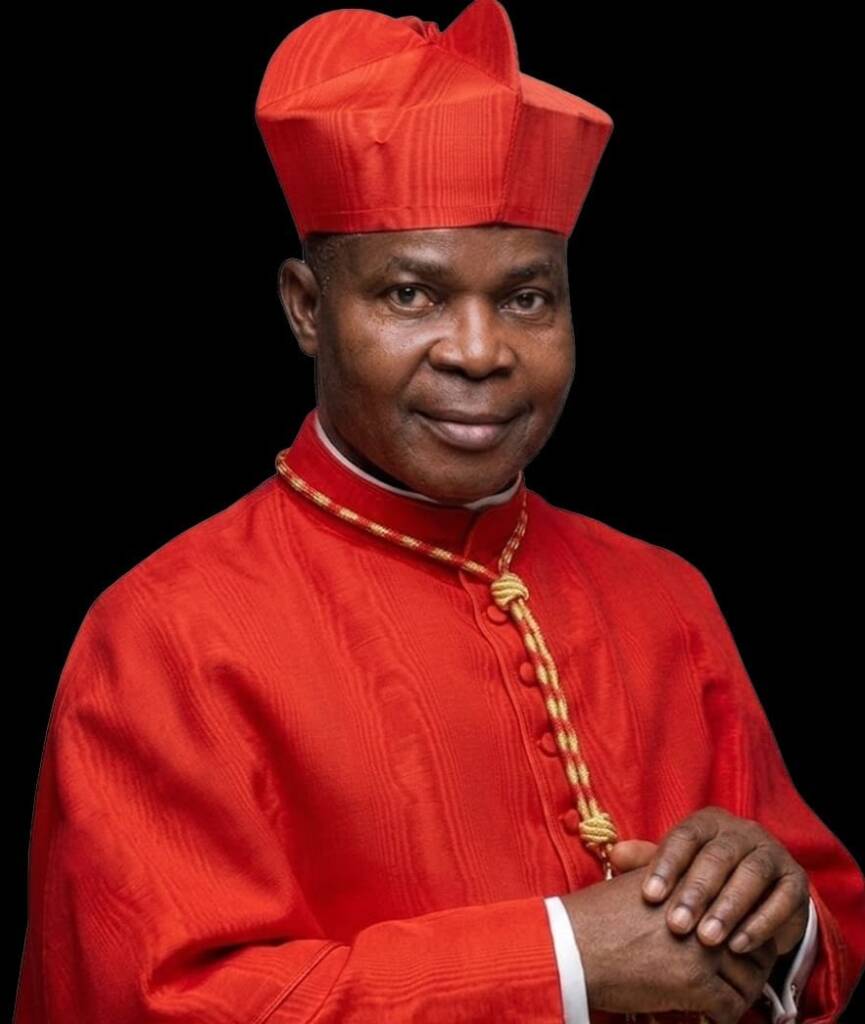
Anthony Cardinal Olubunmi Okogie remains one of the most influential ecclesiastical figures in modern Nigerian history — a revered Prince of the Roman Catholic Church whose life and ministry have profoundly shaped the religious, moral, and socio-political landscape of Nigeria. Renowned for his fearless defense of justice, unwavering commitment to Catholic orthodoxy, and courageous interventions in national affairs, Cardinal Okogie’s legacy transcends the sanctuary and extends into the broader conscience of the Nigerian nation.
For almost six decades in active ministry, he stood at the intersection of faith, public morality, and national leadership, becoming a symbol of integrity, discipline, courage, and prophetic witness. Whether confronting military dictatorship, defending the oppressed, promoting Catholic education, or preserving doctrinal fidelity within the Church, Cardinal Okogie distinguished himself as both a spiritual shepherd and a moral statesman.
Born on June 16, 1936, in Lagos, Anthony Olubunmi Okogie emerged from a deeply religious and culturally distinguished family. His father, Prince Michael Okogie, hailed from the royal lineage of Uromi in present-day Edo State, while his mother, Lucy Adunni Afolabi, was a devout Yoruba Catholic woman known for her discipline and spiritual devotion. Raised in a home where Catholic values, moral discipline, and reverence for faith were deeply cherished, young Anthony developed an early attraction to the spiritual life and sacramental traditions of the Church.
Although born and raised in Lagos, his Esan-Yoruba heritage exposed him to Nigeria’s ethnic and cultural diversity from an early age. This background would later shape his broad national outlook and strengthen his ability to navigate the delicate religious and socio-political complexities of Nigeria.
His educational journey began at St. Mary’s Private School, Lagos, at the remarkably young age of three. Following his father’s transfer to Sapele, he continued his elementary education at St. Patrick’s School before returning to Lagos in 1950 to attend Holy Cross Catholic School. In 1951, he gained admission into St. Gregory’s College, Lagos, one of the most prestigious Catholic colleges in colonial Nigeria.
While academically promising, Okogie increasingly felt drawn to the priesthood. Influenced by missionary priests, the liturgical life of the Church, and the encouragement of his parish priest, Rev. Fr. John Kilbey, SMA, he made the decisive choice in 1953 to leave St. Gregory’s College and enter St. Theresa’s Minor Seminary, Oke-Are, Ibadan. He later proceeded to Saints Peter and Paul Major Seminary, Bodija, Ibadan, where he studied philosophy and theology in preparation for the priesthood.
In 1963, his theological formation took a significant turn when Archbishop John Kwao Amuzu Aggey selected him, alongside Felix Alaba Job, for advanced ecclesiastical studies in Rome. The opportunity reflected the confidence Church authorities already had in his intellectual abilities, discipline, and spiritual maturity. Although initially apprehensive about the rigours of Roman theological education and the challenge of Latin studies, Okogie embraced the assignment with obedience and determination.
At the Pontifical Urban University in Rome, he immersed himself in theology, philosophy, ecclesiology, canon law, and Catholic social teaching. His years in Rome broadened his understanding of the universal Church and deepened his appreciation of the global dimensions of Catholicism. The experience also sharpened his intellectual formation and prepared him for future leadership responsibilities within the Church.
Anthony Okogie was ordained a Catholic priest on December 4, 1966, at Holy Cross Cathedral, Lagos, at the age of thirty. His ordination coincided with one of the most turbulent periods in Nigerian history, as political instability and ethnic tensions were rapidly escalating toward civil war. Following his ordination, Fr. Okogie served at Holy Cross Cathedral while also working as chaplain and instructor at King’s College, Lagos. During this period, he gained a reputation for discipline, eloquence, pastoral dedication, and intellectual rigour.
Shortly after his ordination, Fr. Okogie briefly returned to Rome to continue his studies. However, the outbreak of the Nigerian Civil War necessitated his immediate return to Nigeria following a directive from Archbishop Aggey. Alongside Fr. Felix Alaba Job, he resumed pastoral duties at a time when the nation was descending into violence and uncertainty.
During the war, Fr. Okogie served as a military chaplain attached to the Nigerian Army and was deployed to the warfront in Port Harcourt. The assignment exposed him directly to the brutal realities of conflict — wounded soldiers, death, destruction, and emotional trauma. Amid the chaos of war, he ministered spiritually and emotionally to both soldiers and civilians, offering consolation, prayers, and moral support.
Those wartime experiences profoundly shaped his understanding of suffering, justice, and human dignity. They also reinforced the courage and moral clarity that would later define his public life and ecclesiastical leadership.
In 1971, at just thirty-four years old, Fr. Okogie was appointed Titular Bishop of Mascula and Auxiliary Bishop of Oyo by Pope Paul VI. He was consecrated on August 29, 1971, at St. Benedict’s Cathedral, Oshogbo, Oyo State.
Following the death of Archbishop Aggey in 1972, Bishop Okogie was recalled to Lagos as Auxiliary Bishop to Bishop Anthony Saliu Sanusi. Barely months later, he received official notification of Pope St. Paul VI appointing him as Metropolitan Archbishop of Lagos from the Apostolic Delegate, Archbishop Amelio Poggi.
On June 17, 1973, just one day after his thirty-seventh birthday, Anthony Olubunmi Okogie was enthroned as Archbishop of Lagos, becoming one of the youngest Catholic archbishops in Nigeria at the time. His enthronement marked the beginning of nearly four decades of remarkable ecclesiastical leadership and institutional transformation.
When Archbishop Okogie assumed leadership of the Archdiocese of Lagos, the local Church consisted of approximately fifteen parishes. By the time of his retirement in 2012, the Archdiocese had grown to well over one hundred parishes, reflecting extraordinary expansion in pastoral outreach, evangelisation, and institutional development.
Under his leadership, the Archdiocese witnessed massive growth in Catholic schools, healthcare institutions, and social welfare initiatives. He strongly emphasised Catholic education, believing that moral and intellectual formation remained essential to nation-building and evangelisation. Numerous schools, colleges, healthcare centres, and pastoral institutions were established or significantly expanded during his episcopacy.
Among the major institutions associated with his leadership were Augustine University, St. Augustine’s College of Education, St. Raphael Divine Mercy Specialist Hospital, and several healthcare outreach centres serving vulnerable communities. He also supported large-scale welfare and humanitarian initiatives, including water treatment projects and social assistance programmes for disadvantaged populations.
Beyond institutional expansion, Archbishop Okogie became widely respected for strengthening clerical discipline, promoting liturgical reverence, and defending Catholic orthodoxy during a period of increasing secularisation and rapid Pentecostal expansion across Nigeria. He remained unwavering in his defense of Catholic teachings on the sanctity of life, marriage, family, priestly celibacy, and ecclesiastical discipline.
His uncompromising doctrinal conservatism earned him admiration among many Catholics who regarded him as a courageous guardian of apostolic tradition. At the same time, critics occasionally viewed his positions as rigid or excessively conservative. Nevertheless, his consistency and fidelity to Church teaching remained unmistakable throughout his ministry.
In October 2003, Pope John Paul II elevated Archbishop Okogie to the College of Cardinals, assigning him the titular church of Beata Vergine Maria del Monte Carmelo a Mostacciano in Rome. His elevation represented not only personal recognition but also acknowledgment of the growing influence of the African Church within global Catholicism.
As a Cardinal, Okogie joined the highest advisory body of the Catholic Church and participated in the papal conclaves that elected Pope Benedict XVI in 2005 and Pope Francis in 2013. Despite the prestige attached to the cardinalate, he remained notably humble and often downplayed personal accomplishments.
Beyond ecclesiastical leadership, Cardinal Okogie emerged as one of Nigeria’s most fearless socio-political voices, especially during the era of military dictatorship. As President of the Catholic Bishops’ Conference of Nigeria from 1988 to 1994 and President of the Christian Association of Nigeria from 1994 to 2000, he transformed religious leadership into a platform for moral resistance and national advocacy.
During the regime of General Sani Abacha and other military administrations, Cardinal Okogie openly condemned authoritarianism, corruption, human rights abuses, arbitrary arrests, and electoral injustice. At a time when many public figures feared speaking against oppressive governments, he consistently used sermons, interviews, pastoral letters, and public statements to demand justice, accountability, and democratic governance.
His fearless interventions earned him enormous respect among civil society groups, religious communities, and ordinary Nigerians who regarded him as a moral compass during periods of national uncertainty.
Cardinal Okogie also became known for his strong defense of human dignity across religious and ethnic boundaries. One of the most internationally publicised moments of his advocacy was his intervention in cases involving women sentenced to death by stoning under Sharia law. Demonstrating extraordinary compassion and courage, he appealed publicly for mercy and justice, reinforcing his reputation as a defender of the oppressed regardless of religious affiliation.
The theological foundation of his activism was deeply rooted in Catholic social teaching, particularly the principles of human dignity, the common good, justice, and moral accountability. Unlike ideological revolutionaries, Cardinal Okogie’s activism remained fundamentally pastoral and non-partisan. He believed that silence in the face of injustice constituted moral complicity and that the Church had a responsibility to function as the conscience of society.
His communication style further amplified his public influence. He was known for being direct, fearless, morally uncompromising, and intellectually articulate. He spoke truth to power without diplomatic ambiguity, earning admiration from both clergy and ordinary citizens.
Following his retirement as Archbishop of Lagos in 2012, Cardinal Okogie remained active in public discourse. He continued mentoring younger clergy, granting interviews, writing commentaries, and speaking on national issues affecting both the Church and society.
Today, Cardinal Anthony Olubunmi Okogie stands as one of the most respected Christian leaders in Nigerian history — a man whose life embodies fidelity to the Gospel, courage in public service, compassion for the oppressed, and unwavering commitment to truth and justice.
From the seminary halls of Ibadan and Rome to the warfronts of civil conflict, from Oyo to leadership in Lagos, from parish ministry to the College of Cardinals, his journey reflects the spiritual, moral, and political evolution of modern Nigeria itself.
His enduring legacy remains that of a Catholic colossus, a fearless shepherd, and one of Nigeria’s most enduring voices of conscience.
